

Longitude And Latitude Of Beijing
| Geography of Beijing | |
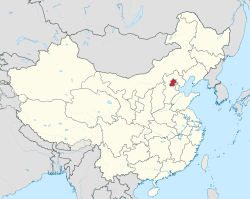
| Location of Beijing Municipality in northern People's republic of china | |
| Satellite image of Beijing Municipality, showing the metropolis of Beijing (in pink) with mountains in the north and west and plains to the east and southward | |
| Continent | Asia |
| Location | North Cathay Plain |
| Coordinates | 39°54′N 116°24′E / 39.900°Northward 116.400°East / 39.900; 116.400 |
| Area (municipality) | Total: sixteen,801 square kilometres (6,487 sq mi) |

Beijing is a municipality located in North China at the northern tip of the Northward Cathay Plain, about the meeting betoken of the Xishan and Yanshan mountain ranges. The city itself lies on flat land (pinnacle 20 to 60 m (66 to 200 ft)) that opens to the east and south. The municipality'south outlying districts and counties extend into the mountains that environs the city from the southwest to the northeast. The highest peaks are over 2,000 chiliad (6,600 ft).
Beijing Municipality consists of half dozen city districts (previously eight, encounter Xuanwu and Chongwen), 8 suburban districts and two rural counties. It covers a total area of 16,807.viii km2 (6,489.5 sq mi). By country area, the municipality is slightly larger than the country of Montenegro, though much of the municipality outside the urban core are sparsely populated mountains and farmland. The terrain is roughly 38% flat and 62% mountainous.[1] The urban center is 150 km (93 mi) inland from the Bohai Sea via Tianjin Municipality in the southeast. Bated from Tianjin, Beijing is bordered on all other sides by Hebei Province, including a slice wedged between Beijing and Tianjin.
Historically, Beijing was situated on the edge betwixt sedentary agricultural areas to the south and pastoralist regions beyond the mountains to the due north. The Great Wall of Cathay was built across the mountains northward of Beijing to baby-sit against nomadic invasions. In mod times, the aforementioned mountains that shielded Beijing from the Gobi steppes also grade a semi-circular basin which catches the urban center's air pollution. Astringent smog bug develop in the summer equally the hot and boiling air pressure from monsoons in the south foreclose air pollutants from leaving the bowl. Smog is less astringent in the fall and wintertime when the management of the wind currents reverse course equally the vast anticyclone high pressure system takes hold and brings cold, dry air from Siberia. In the bound, the northerly winds, choice up grit from desertifying areas of western China and bring occasionally severe dust storms to Beijing. The city's climate is characterized past hot, humid summers and cold, windy, and dry winters.
Layout of Beijing'southward administrative divisions [edit]
In imperial times, the old walled city of Beijing occupied 62 kmtwo (24 sq mi).[1] The concrete size of the city has grown more than tenfold in recent decades to about 750 kmtwo (290 sq mi). The inner suburbs (1,282 km2 or 495 sq mi), and outer suburbs (3,198 km2 or 1,235 sq mi) provide further infinite for growth.[1] The remaining 12,239.ix km2 (iv,725.9 sq mi) of the municipality consists of rural areas, nature reserves and lightly populated mountains.[1]
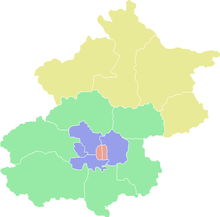
Map showing the core urban center districts (red), surrounding urban districts (bluish), interior suburban districts (green) and the far due north districts and counties (dark yellow)
Two urban districts, Dongcheng and Xicheng form the urban core of Beijing. They occupy the surface area within the old walled city, which used to be divided into ii walled sections, neicheng, the inner metropolis and waicheng, the bordering outer city to the south. Though the city walls no longer stand, they continue to retain geographic significance. Streets that once traversed the wall are still named nei (inner) or wai (outer) in relationship to whether the street section is inside or outside the wall. Today, Line 2 loop of the Beijing Subway traces the inner city wall. The 2nd Ring Road outlines the combined walled city including the outer metropolis.
The inner urban center is divided into eastern and western halves by Dongcheng and Xicheng Districts. The Forbidden City, where emperors once lived, and Tiananmen Square, the center of the city, both belong to Dongcheng. Simply the Zhongnanhai Chemical compound, side by side door to the Forbidden City, where Mainland china's current leaders now reside, and the Peachy Hall of the People, on the due west side of Tiananmen Square, both are part of Xicheng. The outer urban center, next and south of the inner city, comprises the former Xuanwu and Chongwen districts, merged with Xicheng and Dongcheng respectively in July 2010. Chongwen is home to the Temple of Heaven. Xuanwu is oldest continuously inhabited part of Beijing. Some of its neighborhoods including those around the Niujie Mosque (b. 996 A.D.) and Pagoda of Tianning Temple (b. 1119 A.D.) predate the Yuan capital. Dissimilar in nearly other parts of the city, almost narrow lanes in Xuanwu are called jie instead of hutongs. Each of the two core metropolis districts has population density of over 20000 persons/kmtwo (51800 persons/sq. mi.)

Across the 2nd Ring Road, the metropolis spreads out in a checkerboard manner marked by concentric ring roads. Four other districts, Haidian, Chaoyang, Fengtai and Shijingshan, were in one case considered on the metropolis's outskirts, simply are at present integral parts of the city within the 5th Ring Road. All iv have population densities higher up 4500 persons/kmtwo (11,600 persons/km2). The vast Haidian District to the northwest is home to the Quondam and New Summertime Palace, the academy district, and Zhongguancun, the city'south loftier-technology silicon village. The fifty-fifty bigger Chaoyang District embraces the city from the n and eastward. Its possessions include Beijing Central Business organisation Commune (CBD), the Olympic Dark-green, and even the Beijing Capital International Airport.[ii] Shijingshan is a heavily industrialized district in the foothills of the Western Hills. Fengtai spans across the south of urban Beijing.
Of the suburban districts further afield, Tongzhou and Shunyi in the eastward are chop-chop urbanizing. Mentougou and Fangshan prevarication to the westward, in Xishan, also known every bit the Western Hills. Fangshan is habitation to ii of the oldest prehistoric sites in Beijing Municipality: the caves at Zhoukoudian, dwelling house of the Peking Man, and Liulihe, the site of the capital letter of the Yan Kingdom during the Western Zhou dynasty. Daxing District, to the south, is largely agricultural but is as well developing its own technology park in Yizhuang. Changping just north of the city ranges from densely urbanized Tiantongyuan in the south to the Juyongguan Great Wall in the north. In between are the Thirteen Ming Tombs.
Far due north of the municipality in the Yanshan range are Yanqing and Miyun Counties, and Huairou and Pinggu Districts, both of which were rural counties until 2001. The far north is rugged, rural and sparsely populated. Yanqing, Huairou and Miyun all accept fewer than 200 residents per kmii (518/sq. mi.). They are peradventure best known for stretches of the Great Wall, with Badaling and Shuiguan in Yanqing, Mutianyu, Huanghuacheng and Jiankou in Huairou, and Gubeikou and Simatai in Miyun, and Jiangjunguan in Pinggu.
Topography [edit]

The city of Beijing lies on low and flat land, with elevation by and large between 40–60 metres (130–200 ft) above ocean level. The highest signal inside the old walled city is at the meridian of Coal Colina in Jingshan Park, which rises to 88.35 metres (289.ix ft) and overlooks the Forbidden Urban center.[iii] Longevity Hill in the Summer Palace reaches an superlative of 109 metres (358 ft).[4] The plains from Beijing extend to the e every bit far every bit Shanhaiguan on the Bohai Sea and as far south as Nanjing, on the Yangtze River.
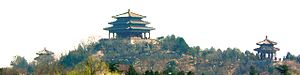
Jingshan, the highest point in the one-time walled city of Beijing
To the due west is Xishan, also known every bit the Western Hills, which are visible from the city on articulate days. Xishan forms the eastern flank of the Taihang Mountains range, which run north–south up the spine of Hebei province.[5] Xishan covers almost all of Fangshan and Mentougou Districts west of the city. East Lingshan (elevation ii,303 metres (vii,556 ft)), a Xishan peak on the border with Hebei, is the highest point in Beijing Municipality.[5] It is located 122 km (76 mi) from the city. Xishan is also known for high mountain meadows and breathtaking river gorges, including Shidu. Foothills of Xishan reach the urban center itself. They include Fragrant Hills, a major tourist attraction and Laoshan, the site of mount bicycle competition in the 2008 Summer Olympics.

Looking north from atop Jingshan Colina along Di'anmen Avenue to the Drum Tower of Beijing. Di'anmen Avenue runs forth Beijing's median axis. Dongcheng District is to the right and Xicheng is to the left. The Yanshan range north of the city is faintly visible in the distance.

Badaling Nifty Wall in the Yanshan range
The mountains due north of Beijing including Badaling, Jundu Mountains and Fenghuanling all belong to the Yanshan range, which runs eastward–west, across northern Hebei Province. Yanshan separates the North Communist china Plain from the steppes and held considerable war machine significance in history. All of Beijing's Keen Wall sections were congenital in the Yanshan range, which reaches a acme of 2,241 1000 (vii,352 ft) at Haituoshan on the border betwixt Yanqing County and Hebei.[5]
The Yanshan and Xishan ranges encounter at Nankou, in Changping District, northwest of the city. The intersection creates a massive error line and rift valley through which the city's principal roads and railroads to the northwest pass.
Hydrology [edit]

Beihai lake and Qiongdao Island in downtown Beijing
Several major rivers, including the Yongding, Chaobai, Juma and Wenyu flow through Beijing Municipality. They originate in the highlands of Hebei and Shanxi, cut through the mountains west and northward of the urban center, and eventually flow into the Hai River, which empties into the Bohai Ocean. Over the centuries, hydrologists have channeled rivers through the city into man-made lakes, moats, channels and aqueducts, which provide water to the city and drain its decline, but no longer threaten Beijing with flooding.

Downtown Beijing has several lakes called hai or bounding main. During the Yuan dynasty, the Mongol rulers expanded them and built royal palace of Dadu effectually them. Subsequent emperors of the Ming and Qing dynasties used the lakes as majestic gardens. Today, the three northernmost lakes, Xihai (W Bounding main), Houhai (Rear Sea) and Qianhai (Front Sea), collectively known as Shichahai, are lined with confined and cafés and known for nightlife. To their southward, Beihai (Due north Sea) is a city park, and Zhonghai (Primal Sea) and Nanhai (Due south Sea) are role of the Zhongnanhai Compound, residence to China's leaders. This string of lakes used to form the primary riverbed of the Yongding River, which now flows 50–60 km (31–37 mi) to the due west. But 1,800 years ago, the Yongding flowed through Jishuitan and downtown Beijing and so into Longtan Lake and on to Tongzhou.[6] A major flood in 295 A.D. devastated office of Beijing, so known as Ji. Just west of Wangfujing, in that location is even so a stretch of Beijing called Shatan or Sandy Beach.

The Tonghui canal, an extension of the Grand Canal, near Gaobeidian

Kunming Lake in the Summer Palace
Today, an aqueduct draws water from the Yongding through Yuyuantan Park to the western city moat, which empties into Liangshui River southward of the city. Another aqueduct draws h2o from Kunming Lake in the Summer Palace down through the Purple Bamboo Park and into the northern urban center moat, which also replenishes Shichahai, Beihai and Zhongnanhai. The northern moats are tuckered past the Ba River, which flows into the Wenyu River. The southern and eastern moats are drained past the Tonghui River, which also flow into the Wenyu.
This network of rivers and aqueducts are fed by reservoirs to the north of the city. The Miyun Reservoir, the largest in the municipality, is created at the confluence of the Chao and Bai Rivers, which forms the Chaobai. The Yongding, before entering the municipality in Mentougou District, is dammed to create the vast Guanting Reservoir of Hebei Province. Despite these reservoirs, the metropolis of Beijing faces chronic water shortages due to water-intensive agriculture, industry, and population growth. Nether the South-Northward Water Transfer Projection, the urban center plans to depict water from the Yangtze River through the M Canal, which was congenital 800 years agone for transportation, but at present is being upgraded into a major aqueduct.
Climate [edit]
| Beijing | ||||||||||||||||||||||||||||||||||||||||||||||||||||||||||||
|---|---|---|---|---|---|---|---|---|---|---|---|---|---|---|---|---|---|---|---|---|---|---|---|---|---|---|---|---|---|---|---|---|---|---|---|---|---|---|---|---|---|---|---|---|---|---|---|---|---|---|---|---|---|---|---|---|---|---|---|---|
| Climate chart (caption) | ||||||||||||||||||||||||||||||||||||||||||||||||||||||||||||
| ||||||||||||||||||||||||||||||||||||||||||||||||||||||||||||
| ||||||||||||||||||||||||||||||||||||||||||||||||||||||||||||
The city's climate is a rather dry out, monsoon-influenced humid continental climate (Köppen climate classification Dwa), characterised by hot, humid summers due to the East Asian monsoon, and generally cold, windy, very dry winters that reflect the influence of the vast Siberian anticyclone.[eight] Even so during the winter, winds from the northwest must cross the mountains that shield the city, keeping the city warmer than other locations of similar breadth in People's republic of china. Spring can prove to sandstorms bravado in from the Mongolian steppe, accompanied past chop-chop warming, but generally dry, conditions. Autumn, like bound, sees piffling rain but is well-baked and short. Jan averages −3.vii °C (25.3 °F), while July averages 26.2 °C (79.2 °F). Annual atmospheric precipitation is around 570 millimetres (22.4 in), falling mostly in the summer months. Extremes have ranged from −27.4 to 42.6 °C (−17 to 109 °F).[9] In 2005, the full precipitation was 410.77 millimetres (sixteen.17 in), a majority of which occurred in the summer.[ten]
| Climate data for Beijing (normals 1986–2015, extremes 1951–nowadays) | |||||||||||||
|---|---|---|---|---|---|---|---|---|---|---|---|---|---|
| Month | Jan | Feb | Mar | April | May | Jun | Jul | Aug | Sep | October | Nov | Dec | Yr |
| Record high °C (°F) | 14.three (57.vii) | 25.6 (78.ane) | 29.5 (85.1) | 33.5 (92.3) | 41.1 (106.0) | 40.half-dozen (105.ane) | 41.9 (107.4) | 38.3 (100.9) | 35.0 (95.0) | 31.0 (87.eight) | 23.3 (73.nine) | 19.v (67.1) | 41.ix (107.4) |
| Average loftier °C (°F) | 2.1 (35.eight) | 5.viii (42.4) | 12.6 (54.vii) | twenty.seven (69.3) | 26.ix (fourscore.iv) | 30.5 (86.nine) | 31.5 (88.seven) | 30.five (86.nine) | 26.2 (79.2) | 19.iv (66.9) | 10.3 (50.5) | 3.8 (38.eight) | 18.4 (65.0) |
| Daily mean °C (°F) | −2.ix (26.viii) | 0.4 (32.7) | 7.0 (44.half-dozen) | 14.ix (58.8) | 21.0 (69.viii) | 25.0 (77.0) | 26.9 (80.iv) | 25.8 (78.4) | twenty.8 (69.4) | 13.eight (56.8) | 5.1 (41.2) | −0.9 (30.4) | xiii.1 (55.five) |
| Average depression °C (°F) | −7.1 (nineteen.2) | −4.iii (24.3) | 1.vi (34.9) | viii.9 (48.0) | 14.ix (58.8) | xix.8 (67.6) | 22.7 (72.9) | 21.7 (71.1) | 16.0 (lx.eight) | 8.8 (47.8) | 0.6 (33.1) | −4.9 (23.2) | eight.2 (46.8) |
| Tape low °C (°F) | −22.viii (−ix.0) | −27.4 (−17.3) | −xv (5) | −3.ii (26.2) | 2.v (36.five) | 9.eight (49.6) | 15.3 (59.five) | 11.4 (52.5) | 3.7 (38.7) | −3.five (25.7) | −12.3 (9.nine) | −18.3 (−0.ix) | −27.4 (−17.three) |
| Average atmospheric precipitation mm (inches) | 2.vii (0.eleven) | 5.0 (0.20) | x.2 (0.40) | 23.ane (0.91) | 39.0 (ane.54) | 76.vii (3.02) | 168.viii (6.65) | 120.2 (4.73) | 57.four (2.26) | 24.1 (0.95) | xiii.1 (0.52) | 2.4 (0.09) | 542.seven (21.38) |
| Boilerplate precipitation days (≥ 0.one mm) | 1.8 | ii.3 | 3.3 | iv.7 | 6.1 | 9.ix | 12.8 | 10.nine | 7.6 | four.eight | 2.9 | 2.0 | 69.1 |
| Average relative humidity (%) | 44 | 43 | 41 | 43 | 49 | 59 | 70 | 72 | 65 | 58 | 54 | 47 | 54 |
| Mean monthly sunshine hours | 186.2 | 188.1 | 227.5 | 242.8 | 267.6 | 225.half dozen | 194.5 | 208.two | 207.5 | 205.two | 174.5 | 172.3 | 2,500 |
| Percent possible sunshine | 65 | 65 | 63 | 64 | 64 | 59 | 47 | 52 | 63 | 64 | 62 | 62 | 60 |
| Boilerplate ultraviolet index | two | 3 | 4 | 6 | eight | nine | 9 | eight | 6 | 4 | 2 | one | v |
| Source: Mainland china Meteorological Administration [11], Cathay Meteorological Data Sharing Service System[12], all-fourth dimension record loftier[9], May record high[13] and Conditions Atlas[14] | |||||||||||||
| Climate information for Beijing (1981–2010,year record 1951-2016) | |||||||||||||
|---|---|---|---|---|---|---|---|---|---|---|---|---|---|
| Month | January | Feb | Mar | April | May | Jun | Jul | Aug | Sep | Oct | November | Dec | Year |
| Record loftier °C (°F) | fourteen.3 (57.7) | 16.1 (61.0) | 29.5 (85.1) | 31.9 (89.4) | 38.1 (100.6) | 39.6 (103.3) | 41.9 (107.4) | 37.3 (99.ane) | 35.0 (95.0) | 31.0 (87.8) | 21.vi (70.9) | 13.four (56.1) | 41.9 (107.4) |
| Average high °C (°F) | 1.8 (35.2) | 6.2 (43.2) | 12.8 (55.0) | twenty.6 (69.1) | 27.0 (80.6) | xxx.seven (87.iii) | 32.1 (89.8) | 30.vi (87.one) | 26.6 (79.nine) | 19.4 (66.9) | 10.2 (50.4) | 3.5 (38.3) | 18.five (65.2) |
| Daily hateful °C (°F) | −3.0 (26.6) | 0.7 (33.three) | 7.ane (44.8) | 14.eight (58.six) | 21.0 (69.8) | 25.one (77.2) | 27.3 (81.1) | 25.9 (78.vi) | 21.ii (70.2) | xiii.9 (57.0) | 5.i (41.2) | −one.ane (xxx.0) | xiii.2 (55.7) |
| Boilerplate low °C (°F) | −seven.3 (xviii.9) | −4.1 (24.6) | 1.8 (35.ii) | 8.9 (48.0) | 15.0 (59.0) | xix.9 (67.8) | 23.1 (73.half dozen) | 21.8 (71.2) | 16.3 (61.3) | 8.9 (48.0) | 0.6 (33.one) | −5.1 (22.viii) | 8.3 (47.0) |
| Record low °C (°F) | −17 (i) | −14.7 (5.v) | −8 (eighteen) | −0.i (31.8) | 7.seven (45.nine) | ix.8 (49.6) | xvi.0 (sixty.8) | 14.6 (58.3) | 7.five (45.5) | −3.4 (25.9) | −ix.five (fourteen.9) | −13.5 (vii.7) | −27.4 (−17.iii) |
| Average atmospheric precipitation mm (inches) | 2.8 (0.11) | 4.four (0.17) | 9.nine (0.39) | 23.7 (0.93) | 37.half-dozen (1.48) | seventy.v (ii.78) | 159.6 (half-dozen.28) | 139.4 (5.49) | 48.7 (ane.92) | 23.9 (0.94) | 9.vi (0.38) | 2.0 (0.08) | 532.1 (20.95) |
| Source: China Meteorological Administration[15] | |||||||||||||
Coordinates [edit]

Map of the earth centered at Beijing
With coordinates of 39° 54' fifty N and 116° 23' 30" E, Beijing shares roughly the aforementioned latitude equally Denver, Indianapolis, Columbus (Ohio), Philadelphia, Ankara, Bukhara, equally well equally Jiayuguan, Yumen, and Jiuquan in Gansu. The urban center lines up at nigh the same longitude as Xilinhot, Inner Mongolia; Dezhou, Shandong; Yongcheng, Henan; Lu'an, Anhui; Linchuan, Jiangxi; Changting, Fujian; Jieyang, Guangdong; Kota Kinabalu, Malaysia; and Mataram, Indonesia. The latitude of the municipality ranges from 39° 27' to 41° 03' N and in longitude from 115° 25' to 117° 30' East.
Beijing's antipode is located in the eastern role of Río Negro Province, Argentina, inland from Viedma.
Maps and satellite images [edit]
-

Beijing's urban extent
-
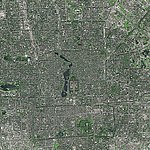
Satellite image of the city of Beijing, with the Forbidden City in the centre, only north of Tiananmen Square and eastward of a string of lakes. Also visible are Yuyuantan lake in the west and the southern city moat, which once surrounded the walled outer city.
-
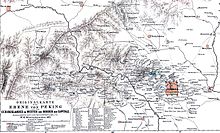
The Beijing surface area in 1875
-

Beijing in 1912
-

The old city in 1916
-
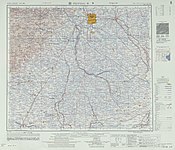
Map of Beijing (labeled as PEI-P'ING (PEIPING) 北平 ) and nearby areas (1954)
-

Beijing and vicinity in 1986
-

Map showing the old walled city, including the inner and outer cities
Animation zooming down to Beijing in 1978 via Landsat-iii. The data then dissolves to Beijing in 2010 through the sensors of Landsat-5. The red areas are non-vegetated urban areas.
Run across also [edit]
- Neighborhoods in Beijing
- Geography of China
- Northward People's republic of china Plain
References [edit]
- ^ a b c d (Chinese) 北京地理概貌 terminal accessed 11/18/08
- ^ The Beijing Capital Airport and the highway connecting it to the city are administered past Chaoyang District even though the airdrome is almost completely surrounded by Shunyi District.
- ^ (Chinese) Jingshan Park Archived 2008-08-04 at the Wayback Machine
- ^ (Chinese) Summertime Palace Archived 2007-08-xiv at the Wayback Machine
- ^ a b c (Chinese) [1] concluding accessed eleven/16/08
- ^ (Chinese)陈平, 三、什刹海与陶然湖、古蓟城 June 6, 2008
- ^ 中国地面国际交换站气候标准值月值数据集(1981-2010年) (in Chinese). People's republic of china Meteorological Administration. Archived from the original on 2013-03-18. Retrieved 2015-01-15 .
- ^ "Beijing". People's Daily. March 2001. Retrieved 2008-06-22 .
- ^ a b "Extreme Temperatures Effectually the World". Retrieved 2013-02-21 .
- ^ "Basic Information". Beijing Municipal Agency of Statistics. Archived from the original on 2012-03-13. Retrieved 2008-02-09 .
- ^ 中国地面国际交换站气候标准值月值数据集(1971-2000年) (in Chinese). Prc Meteorological Administration. Retrieved 2010-05-04 .
- ^ "Beijing". Communist china Meteorological Data Sharing Service Organisation. December 2013. Retrieved January one, 2014.
- ^ Burt, Christopher C. "UPDATE June 1: Record May Heat Moving ridge in Northeast China, Koreas". Wunderground. Retrieved 2014-06-01 .
- ^ d.o.o, Yu Media Grouping. "Beijing, China - Detailed climate information and monthly weather forecast". Conditions Atlas . Retrieved 2019-07-09 .
- ^ 中国地面国际交换站气候标准值月值数据集(1981-2010年) (in Chinese). China Meteorological Administration. Archived from the original on 2013-03-xviii. Retrieved 2015-01-15 .
External links [edit]
- "Peking", a map from 1914

Longitude And Latitude Of Beijing,
Source: https://en.wikipedia.org/wiki/Geography_of_Beijing
Posted by: kellylucian36.blogspot.com
0 Response to "Longitude And Latitude Of Beijing"
Post a Comment