

Area Between Curves Absolute Value
Evidence Mobile Notice Bear witness All NotesHibernate All Notes
Mobile Notice
You lot appear to exist on a device with a "narrow" screen width (i.e. you lot are probably on a mobile phone). Due to the nature of the mathematics on this site it is all-time views in landscape style. If your device is not in mural mode many of the equations will run off the side of your device (should be able to scroll to run across them) and some of the menu items will be cut off due to the narrow screen width.
Section 6-2 : Area Between Curves
In this section we are going to expect at finding the area between two curves. There are actually two cases that we are going to exist looking at.
In the beginning case nosotros want to determine the surface area between \(y = f\left( ten \correct)\) and \(y = g\left( x \right)\) on the interval \(\left[ {a,b} \right]\). Nosotros are besides going to assume that \(f\left( x \correct) \ge yard\left( 10 \right)\). Have a expect at the following sketch to get an idea of what we're initially going to look at.
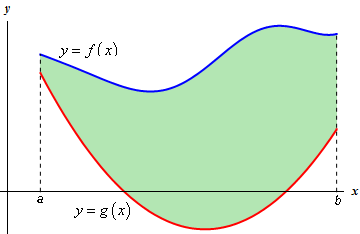
In the Area and Volume Formulas department of the Extras chapter nosotros derived the following formula for the area in this instance.
\[\brainstorm{equation}A = \int_{{\,a}}^{{\,b}}{{f\left( x \right) - yard\left( x \right)\,dx}}\characterization{eq:eq1}\end{equation}\]
The second example is most identical to the first case. Here we are going to determine the area betwixt \(ten = f\left( y \right)\) and \(ten = g\left( y \right)\) on the interval \(\left[ {c,d} \right]\) with \(f\left( y \right) \ge yard\left( y \right)\).
In this case the formula is,
\[\begin{equation}A = \int_{{\,c}}^{{\,d}}{{f\left( y \right) - one thousand\left( y \right)\,dy}}\label{eq:eq2}\end{equation}\]
At present \(\eqref{eq:eq1}\) and \(\eqref{eq:eq2}\) are perfectly serviceable formulas, however, it is sometimes easy to forget that these always crave the commencement function to be the larger of the two functions. And so, instead of these formulas we will instead utilize the following "discussion" formulas to brand sure that we remember that the area is ever the "larger" role minus the "smaller" function.
In the first instance we volition use,
\[\begin{equation}A = \int_{{\,a}}^{{\,b}}{{\left( \brainstorm{array}{c}{\mbox{upper}}\\ {\mbox{function}}\end{array} \right) - \left( \begin{assortment}{c}{\mbox{lower}}\\ {\mbox{part}}\end{array} \correct)\,dx}},\hspace{0.5in}a \le x \le b\label{eq:eq3}\end{equation}\]
In the second case we volition use,
\[\begin{equation}A = \int_{{\,c}}^{{\,d}}{{\left( \begin{array}{c}{\mbox{right}}\\ {\mbox{function}}\end{assortment} \right) - \left( \begin{assortment}{c}{\mbox{left}}\\ {\mbox{function}}\stop{array} \right)\,dy}},\hspace{0.5in}c \le y \le d \label{eq:eq4}\cease{equation}\]
Using these formulas will always force u.s.a. to think about what is going on with each problem and to make certain that we've got the correct order of functions when we become to use the formula.
Allow's piece of work an example.
Instance 1 Make up one's mind the area of the region enclosed past \(y = {x^two}\) and \(y = \sqrt x \).
Bear witness Solution
Showtime of all, just what practice we mean by "area enclosed by". This means that the region we're interested in must have one of the two curves on every purlieus of the region. So, here is a graph of the two functions with the enclosed region shaded.
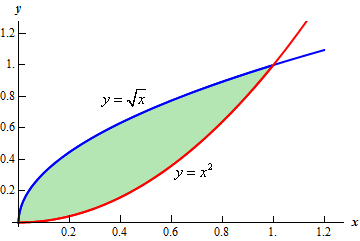
Notation that we don't take whatsoever part of the region to the right of the rightmost intersection signal of these two graphs. In this region in that location is no boundary on the right side so this region is not function of the enclosed area. Remember that 1 of the given functions must be on the boundary of the enclosed region.
Besides, from this graph information technology'southward clear that the upper function will be dependent on the range of \(10\)'s that we use. Because of this you should e'er sketch of a graph of the region. Without a sketch it'due south often easy to mistake which of the ii functions is the larger. In this case nearly would probably say that \(y = {10^ii}\) is the upper function and they would exist right for the vast majority of the \(x\)'due south. Nevertheless, in this instance it is the lower of the two functions.
The limits of integration for this will be the intersection points of the two curves. In this case it's pretty easy to run across that they will intersect at \(x = 0\) and \(x = one\) so these are the limits of integration.
So, the integral that nosotros'll need to compute to find the area is,
\[\begin{marshal*}A & = \int_{{\,a}}^{{\,b}}{{\left( \begin{array}{c}{\mbox{upper}}\\ {\mbox{function}}\end{array} \right) - \left( \begin{array}{c}{\mbox{lower}}\\ {\mbox{office}}\end{assortment}\correct)\,dx}}\\ & = \int_{{\,0}}^{{\,i}}{{\sqrt x - {x^ii}\,dx}}\\ & = \left. {\left( {\frac{2}{three}{10^{\frac{iii}{2}}} - \frac{i}{3}{x^three}} \right)} \correct|_0^ane\\ & = \frac{1}{3}\terminate{align*}\]
Before moving on to the next example, there are a couple of important things to note.
Get-go, in almost all of these problems a graph is pretty much required. Oft the bounding region, which will give the limits of integration, is difficult to decide without a graph.
Besides, it can frequently be difficult to make up one's mind which of the functions is the upper function and which is the lower part without a graph. This is specially true in cases like the concluding example where the respond to that question actually depended upon the range of \(10\)'due south that we were using.
Finally, unlike the area under a bend that we looked at in the previous chapter the surface area between two curves volition always be positive. If we get a negative number or zero nosotros can exist sure that we've made a fault somewhere and volition need to go back and find it.
Note as well that sometimes instead of maxim region enclosed by nosotros volition say region bounded by. They mean the same thing.
Allow'south work some more than examples.
Example 2 Determine the surface area of the region bounded by \(y = 10{{\bf{e}}^{ - {x^ii}}}\), \(y = 10 + ane\), \(10 = 2\), and the \(y\)-axis.
Show Solution
In this instance the last two pieces of information, \(x = 2\) and the \(y\)-axis, tell us the right and left boundaries of the region. Also, recall that the \(y\)-axis is given by the line \(x = 0\). Here is the graph with the enclosed region shaded in.
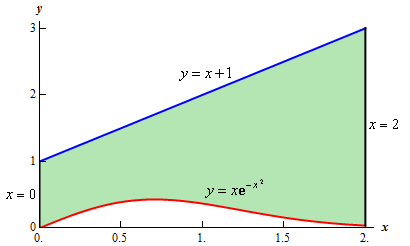
Here, unlike the first example, the two curves don't come across. Instead we rely on ii vertical lines to spring the left and right sides of the region as we noted above
Hither is the integral that will give the surface area.
\[\brainstorm{align*}A & = \int_{{\,a}}^{{\,b}}{{\left( \begin{array}{c}{\mbox{upper}}\\ {\mbox{function}}\stop{assortment} \right) - \left( \begin{array}{c}{\mbox{lower}}\\ {\mbox{function}}\end{assortment} \right)\,dx}}\\ & = \int_{{\,0}}^{{\,2}}{{x + 1 - x{{\bf{east}}^{ - {x^2}}}\,dx}}\\ & = \left. {\left( {\frac{1}{ii}{x^two} + x + \frac{1}{2}{{\bf{e}}^{ - {x^two}}}} \right)} \right|_0^ii\\ & = \frac{7}{2} + \frac{{{{\bf{eastward}}^{ - four}}}}{2} = iii.5092\end{marshal*}\]
Example 3 Determine the area of the region bounded past \(y = ii{x^2} + x\)and \(y = 4x + sixteen\).
Bear witness Solution
In this case the intersection points (which we'll need eventually) are not going to be easily identified from the graph so let's go ahead and go them at present. Note that for most of these problems you'll not be able to accurately place the intersection points from the graph and so you'll need to exist able to decide them by hand. In this example nosotros tin can get the intersection points by setting the two equations equal.
\[\begin{marshal*}ii{10^2} + 10 & = 4x + 16\\ 2{x^2} - 4x - 6 & = 0\\ 2\left( {x + i} \right)\left( {x - iii} \right) & = 0\end{marshal*}\]
So, it looks like the two curves will intersect at \(x = - i\) and \(10 = iii\). If we need them we can get the \(y\) values corresponding to each of these by plugging the values back into either of the equations. We'll get out it to you to verify that the coordinates of the two intersection points on the graph are \(\left( { - ane,12} \right)\) and \(\left( {3,28} \right)\).
Notation as well that if y'all aren't good at graphing knowing the intersection points tin can help in at least getting the graph started. Here is a graph of the region.
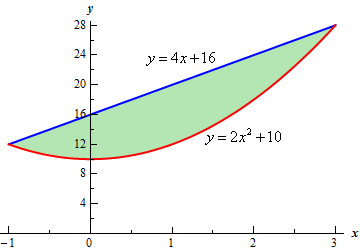
With the graph we can now identify the upper and lower function and so nosotros can now find the enclosed area.
\[\brainstorm{align*}A &= \int_{{\,a}}^{{\,b}}{{\left( \brainstorm{array}{c}{\mbox{upper}}\\ {\mbox{function}}\end{assortment} \right) - \left( \begin{array}{c}{\mbox{lower}}\\ {\mbox{function}}\end{assortment} \right)\,dx}}\\ & = \int_{{\, - 1}}^{{\,3}}{{4x + 16 - \left( {2{x^ii} + 10} \right)\,dx}}\\ & = \int_{{\, - 1}}^{{\,3}}{{ - 2{x^2} + 4x + 6\,dx}}\\ & = \left. {\left( { - \frac{2}{3}{x^3} + 2{x^2} + 6x} \correct)} \right|_{ - 1}^3\\ & = \frac{{64}}{3}\end{align*}\]
Be careful with parenthesis in these bug. One of the more mutual mistakes students make with these problems is to neglect parenthesis on the second term.
Example 4 Determine the area of the region divisional by \(y = two{10^2} + 10\), \(y = 4x + 16\), \(x = - ii\) and \(ten = 5\).
Evidence Solution
And so, the functions used in this problem are identical to the functions from the start problem. The difference is that we've extended the divisional region out from the intersection points. Since these are the same functions nosotros used in the previous case we won't carp finding the intersection points again.
Here is a graph of this region.
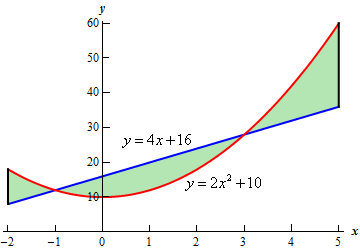
Okay, we have a modest trouble here. Our formula requires that one office ever exist the upper function and the other part always be the lower office and we conspicuously exercise not have that here. However, this actually isn't the problem that it might at showtime appear to exist. There are three regions in which i function is always the upper role and the other is always the lower function. Then, all that we need to do is find the area of each of the three regions, which nosotros tin practise, and and so add them all up.
Here is the area.
\[\begin{marshal*}A & = \int_{{\, - 2}}^{{\, - 1}}{{ii{ten^ii} + 10 - \left( {4x + 16} \right)\,dx}} + \int_{{\, - 1}}^{{\,3}}{{4x + 16 - \left( {2{x^two} + 10} \right)\,dx}} + \int_{{\,3}}^{{\,5}}{{2{x^2} + 10 - \left( {4x + 16} \right)\,dx}}\\ & = \int_{{\, - 2}}^{{\, - 1}}{{2{x^2} - 4x - six\,dx}} + \int_{{\, - one}}^{{\,three}}{{ - 2{x^ii} + 4x + 6\,dx}} + \int_{{\,3}}^{{\,five}}{{2{10^2} - 4x - 6\,dx}}\\ & = \left. {\left( {\frac{2}{3}{x^3} - two{x^2} - 6x} \right)} \right|_{ - 2}^{ - 1} + \left. {\left( { - \frac{ii}{3}{ten^3} + 2{x^2} + 6x} \right)} \right|_{ - 1}^iii + \left. {\left( {\frac{2}{3}{x^3} - 2{x^ii} - 6x} \correct)} \right|_3^5\\ & = \frac{{14}}{3} + \frac{{64}}{3} + \frac{{64}}{3}\\ & = \frac{{142}}{3}\end{align*}\]
Instance 5 Determine the area of the region enclosed by \(y = \sin x\), \(y = \cos x\), \(x = \frac{\pi }{2}\), and the \(y\)-axis.
Show Solution
First let'southward get a graph of the region.
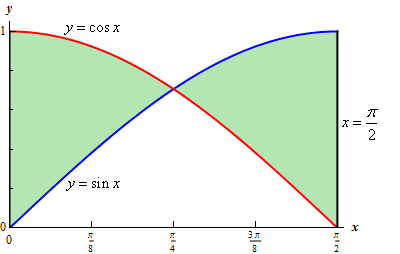
So, we have another situation where nosotros will need to practise two integrals to go the area. The intersection point will be where
\[\sin x = \cos x\]
in the interval. Nosotros'll leave it to you to verify that this will exist \(x = \frac{\pi }{4}\). The area is then,
\[\begin{align*}A & = \int_{{\,0}}^{{\,\frac{\pi }{4}}}{{\cos x - \sin x\,dx}} + \int_{{\,{\pi }/{4}\;}}^{{\,{\pi }/{two}\;}}{{\sin ten - \cos ten\,dx}}\\ & = \left. {\left( {\sin x + \cos x} \right)} \right|_0^{\frac{\pi }{4}} + \left. {\left( { - \cos x - \sin 10} \right)} \correct|_{{\pi }/{iv}\;}^{{\pi }/{2}\;}\\ & = \sqrt 2 - 1 + \left( {\sqrt ii - 1} \correct)\\ & = 2\sqrt 2 - ii = 0.828427\end{align*}\]
Nosotros will need to be careful with this next instance.
Example 6 Make up one's mind the area of the region enclosed past \(ten = \frac{1}{2}{y^2} - 3\) and \(y = x - one\).
Evidence Solution
Don't let the beginning equation get y'all upset. We will take to deal with these kinds of equations occasionally and then we'll need to get used to dealing with them.
As always, it will help if we have the intersection points for the two curves. In this case nosotros'll get the intersection points past solving the 2d equation for \(ten\) and then setting them equal. Hither is that piece of work,
\[\begin{align*}y + ane & = \frac{1}{2}{y^ii} - 3\\ 2y + two & = {y^2} - 6\\ 0 & = {y^ii} - 2y - viii\\ 0 & = \left( {y - iv} \right)\left( {y + 2} \right)\end{marshal*}\]
And so, information technology looks like the 2 curves will intersect at \(y = - 2\) and \(y = 4\) or if nosotros need the total coordinates they will be : \(\left( { - 1, - two} \right)\) and \(\left( {5,four} \correct)\).
Hither is a sketch of the two curves.
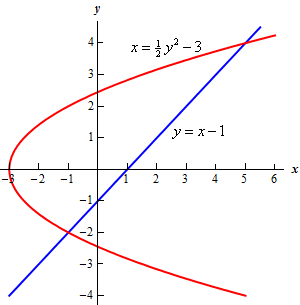
Now, we will have a serious problem at this point if we aren't careful. To this point we've been using an upper function and a lower function. To do that here observe that there are actually two portions of the region that volition have different lower functions. In the range \(\left[ { - 3, - ane} \right]\) the parabola is actually both the upper and the lower function.
To use the formula that we've been using to this bespeak we demand to solve the parabola for \(y\). This gives,
\[y = \pm \sqrt {2x + half dozen} \]
where the "+" gives the upper portion of the parabola and the "-" gives the lower portion.
Hither is a sketch of the consummate area with each region shaded that we'd need if we were going to use the commencement formula.
The integrals for the area would then be,
\[\begin{align*}A & = \int_{{\, - 3}}^{{\, - 1}}{{\sqrt {2x + 6} - \left( { - \sqrt {2x + 6} } \right)\,dx}} + \int_{{\, - 1}}^{{\,5}}{{\sqrt {2x + vi} - \left( {ten - 1} \correct)\,dx}}\\ & = \int_{{\, - 3}}^{{\, - 1}}{{two\sqrt {2x + 6} \,dx}} + \int_{{\, - one}}^{{\,5}}{{\sqrt {2x + six} - x + 1\,dx}}\\ & = \int_{{\, - three}}^{{\, - 1}}{{two\sqrt {2x + six} \,dx}} + \int_{{\, - 1}}^{{\,5}}{{\sqrt {2x + half-dozen} \,dx}} + \int_{{\, - i}}^{{\,five}}{{ - x + 1\,dx}}\\ & = \left. {\frac{two}{iii}{u^{\frac{3}{2}}}} \right|_0^4 + \left. {\frac{1}{3}{u^{\frac{iii}{2}}}} \right|_4^{16} + \left. {\left( { - \frac{i}{2}{10^2} + 10} \right)} \right|_{ - one}^5\\ & = 18\terminate{align*}\]
While these integrals aren't terribly difficult they are more difficult than they demand to exist.
Recollect that there is another formula for determining the expanse. It is,
\[A = \int_{{\,c}}^{{\,d}}{{\left( \begin{array}{c}{\mbox{correct}}\\ {\mbox{part}}\end{assortment} \correct) - \left( \begin{array}{c}{\mbox{left}}\\ {\mbox{function}}\end{assortment} \correct)\,dy}},\hspace{0.5in}c \le y \le d\]
and in our case we do have 1 office that is ever on the left and the other is e'er on the right. And so, in this case this is definitely the way to go. Note that we will need to rewrite the equation of the line since it will need to be in the course \(x = f\left( y \right)\) simply that is easy plenty to do. Hither is the graph for using this formula.
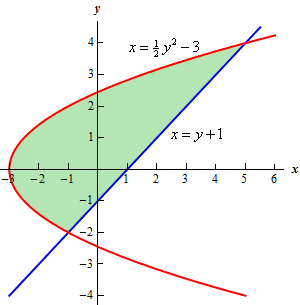
The area is,
\[\begin{align*}A & = \int_{{\,c}}^{{\,d}}{{\left( \brainstorm{array}{c}{\mbox{right}}\\ {\mbox{part}}\end{array} \right) - \left( \begin{assortment}{c}{\mbox{left}}\\ {\mbox{function}}\finish{array} \right)\,dy}}\\ & = \int_{{\, - 2}}^{{\,iv}}{{\left( {y + 1} \correct) - \left( {\frac{1}{2}{y^2} - iii} \right)\,dy}}\\ & = \int_{{\, - 2}}^{{\,four}}{{ - \frac{1}{ii}{y^two} + y + four\,dy}}\\ & = \left. {\left( { - \frac{1}{six}{y^3} + \frac{ane}{2}{y^2} + 4y} \correct)} \right|_{ - 2}^4\\ & = 18\end{marshal*}\]
This is the aforementioned that nosotros got using the beginning formula and this was definitely easier than the offset method.
So, in this concluding instance we've seen a case where we could apply either formula to detect the area. Withal, the second was definitely easier.
Students often come into a calculus form with the idea that the just piece of cake fashion to work with functions is to use them in the class \(y = f\left( 10 \correct)\). Nonetheless, as nosotros've seen in this previous example there are definitely times when it will exist easier to piece of work with functions in the form \(x = f\left( y \right)\). In fact, in that location are going to be occasions when this will exist the only way in which a problem tin can be worked so make sure that you can bargain with functions in this course.
Let's take a look at i more than example to make sure nosotros can bargain with functions in this form.
Example 7 Determine the area of the region bounded by \(x = - {y^two} + 10\) and \(x = {\left( {y - 2} \right)^2}\).
Show Solution
Get-go, nosotros will need intersection points.
\[\begin{marshal*} - {y^2} + 10 & = {\left( {y - 2} \correct)^2}\\ - {y^2} + 10 & = {y^2} - 4y + iv\\ 0 & = two{y^2} - 4y - 6\\ 0 & = 2\left( {y + 1} \right)\left( {y - 3} \correct)\end{align*}\]
The intersection points are \(y = - 1\) and \(y = iii\). Here is a sketch of the region.
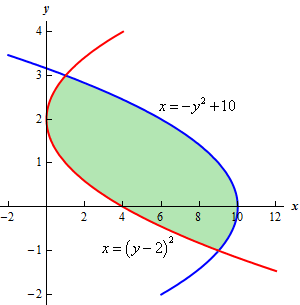
This is definitely a region where the second area formula volition be easier. If we used the first formula in that location would be 3 different regions that nosotros'd accept to look at.
The area in this instance is,
\[\begin{align*}A & = \int_{{\,c}}^{{\,d}}{{\left( \begin{assortment}{c}{\mbox{right}}\\ {\mbox{role}}\end{array} \right) - \left( \brainstorm{array}{c}{\mbox{left}}\\ {\mbox{function}}\end{array} \right)\,dy}}\\ & = \int_{{\, - i}}^{{\,3}}{{ - {y^2} + 10 - {{\left( {y - 2} \right)}^two}\,dy}}\\ & = \int_{{\, - 1}}^{{\,3}}{{ - 2{y^2} + 4y + 6\,dy}}\\ & = \left. {\left( { - \frac{2}{3}{y^3} + 2{y^two} + 6y} \right)} \right|_{ - i}^3 = \frac{{64}}{3}\end{align*}\]

Area Between Curves Absolute Value,
Source: https://tutorial.math.lamar.edu/Classes/CalcI/AreaBetweenCurves.aspx
Posted by: kellylucian36.blogspot.com
0 Response to "Area Between Curves Absolute Value"
Post a Comment