

3d Shape With 5 Faces
A 3D shape or an object is fabricated upwardly of a combination of certain parts. Almost of the solid figures consist of polygonal regions. These regions are- faces, edges, and vertices. Solid geometric shapes which have faces, edges and vertices are known every bit polyhedrons.
Faces of 3D Shapes
- The flat surface of a polyhedron is its face. Solid shapes can have more than one face. The cube shown beneath has half-dozen faces viz. ABCD, EFGH, ADHE, DHGC, BFGC, and AEFB.
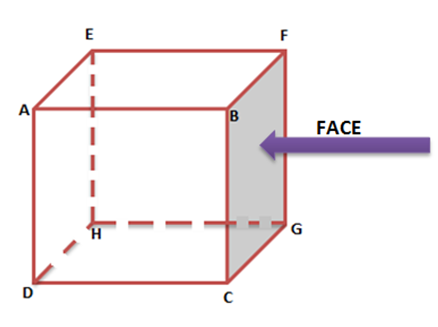
- Cubes and cuboids accept 6 faces.
- Cones have a flat face and a curved face.
- Cylinders take 2 flat faces and a curved face.
- A sphere has a curved face up.
Edges of 3D Shapes
- The faces meet each other at edges. Edges are straight lines which serve equally the junction of two faces. The cube shown beneath has 12 edges namely AB, BF, EF, AE, Advertizement, DH, EH, HG, FG, BC, CG, and CD.
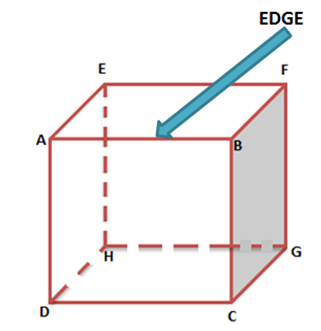
- Cubes and cuboids take 12 edges.
- Cones take one edge.
- Cylinders have 2 edges.
- A sphere has no edge.
Vertices of 3D Shapes
- The points of intersection of edges denote the vertices. Vertices are represented by points. In the cube shown below A, B, C, D, East, F, G, and H are the viii vertices of the cube.
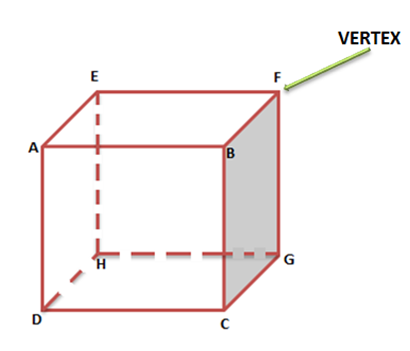
- Cubes and cuboids accept viii vertices.
- Cones have 1 vertex.
- Cylinders have no vertex.
- Spheres have no vertex (the surface is a curve).
Now that, we are familiar with polyhedrons let's motility onto to their types.
Types of Polyhedron
- Convex Polyhedron: If the surface of a polyhedron (which consists of its faces, edges, and vertices) does not intersect itself and the line segment connecting whatever two points of the polyhedron lies within its interior part or surface then such a polyhedron is a convex polyhedron.
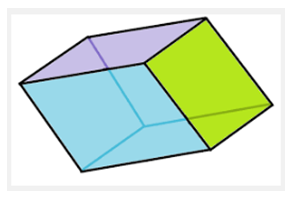
- Concave Polyhedron: A non-convex polyhedron is termed equally a concave polyhedron.
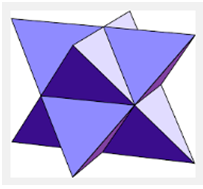
Euler'due south Formula :
According to Euler'southward formula for any convex polyhedron, the number of Faces (F) and vertices (V) added together is exactly two more than the number of edges (E).
F + V = ii + E
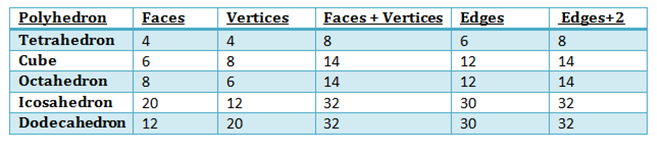
A polyhedron is known as a regular polyhedron if all its faces constitute regular polygons and at each vertex the same number of faces intersect.
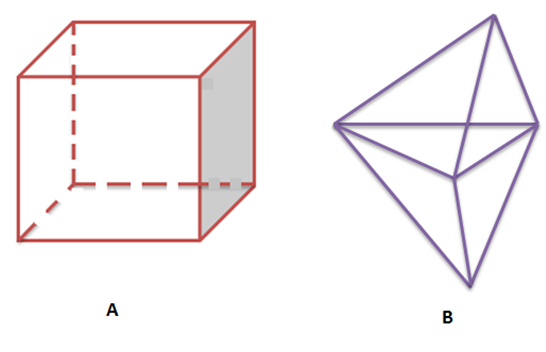
Fig A is a regular polyhedron as all the faces are regular polygons and B is an irregular polygon.
To know more than well-nigh ii dimensional and three-dimensional shapes, visit our site BYJU'South.


3d Shape With 5 Faces,
Source: https://byjus.com/maths/faces-edges-and-vertices/
Posted by: kellylucian36.blogspot.com
0 Response to "3d Shape With 5 Faces"
Post a Comment